The Quilt Labels Told the Truth
The Quilt Labels Told the Truth begins with a missing sewing machine, a family accusation, and the quiet proof Aunt Lila had been keeping all along.
The Quilt Labels Told the Truth
Everyone in the family believed Aunt Lila had stolen Grandma Rose’s sewing machine.
No one saw her take it.
No one had proof.
But after the funeral, when the house grew quiet and the sewing machine disappeared from its place by the front window, the family needed someone to blame.
So they blamed Lila.
“She always wanted Grandma’s best things,” Cousin Mark said.
“She probably sold it,” another cousin whispered.
The rumor moved from the kitchen to phone calls, from phone calls to family messages, until it no longer sounded like a rumor.
It sounded like fact.
The sewing machine had been Grandma Rose’s favorite thing.
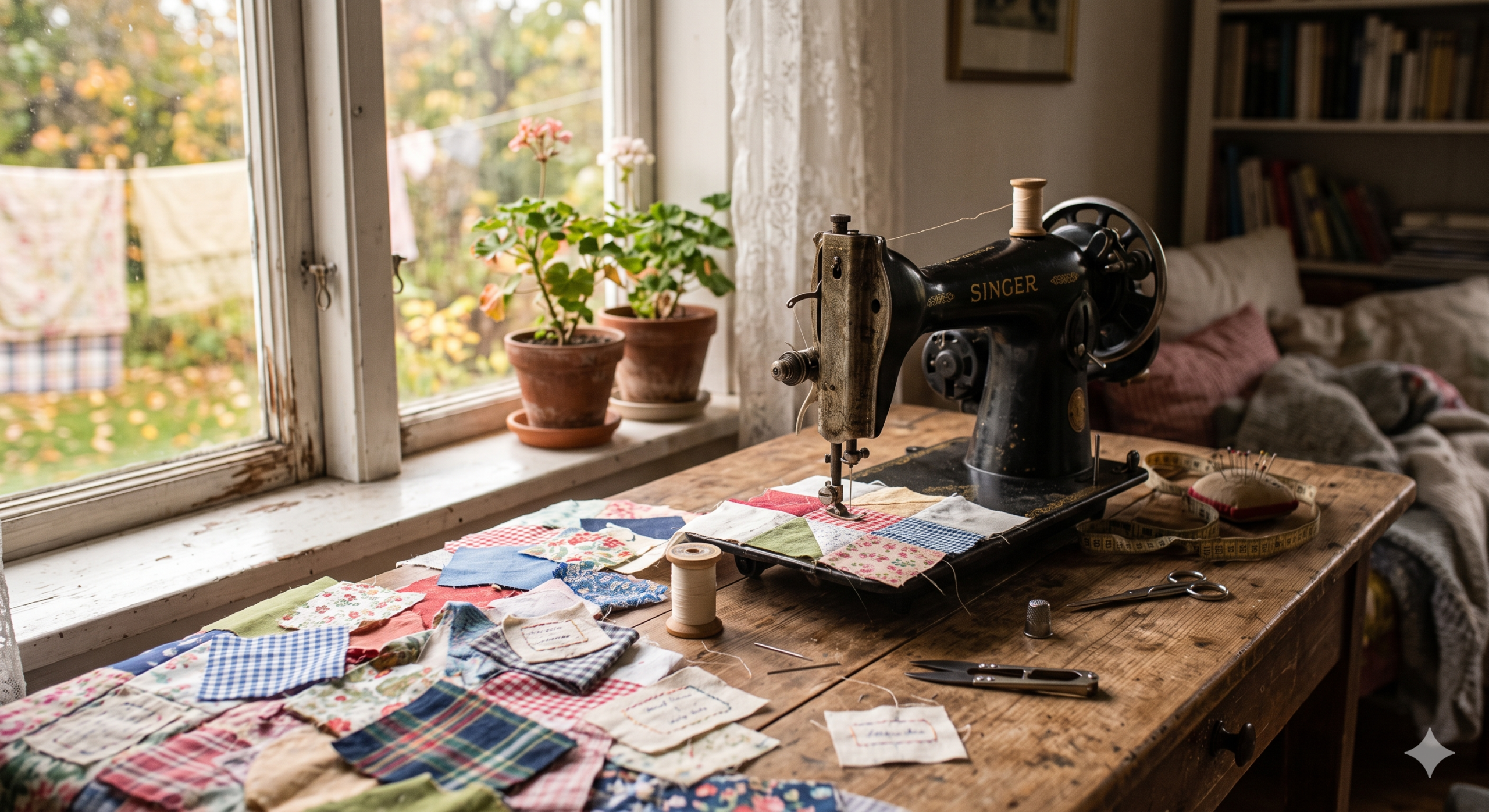
For years, it sat beside the front window, covered with a white cloth when she was not using it. Rose used it to mend school uniforms, shorten curtains, make baby blankets, and turn old shirts into pillowcases.
When the machine hummed, the whole house felt alive.
But after Rose died, the house felt hollow.
Her teacup was still by the sink.
Her slippers were still under the chair.
Her lavender soap was still beside the bathroom basin.
Only the sewing machine was gone.
And Aunt Lila would not explain.
“It is safe,” she said softly.
That made everyone angrier.
To them, “safe” sounded like “hidden.”
And hidden sounded like guilty.
Lila had been Rose’s youngest daughter. She had never married and had no children of her own. For six years, she had taken care of her mother quietly.
She drove Rose to appointments.
She cooked when Rose’s hands shook.
She slept on the sofa when Rose was afraid to be alone at night.
But after the funeral, all of that seemed to vanish from the family’s memory.
They remembered only one thing.
The sewing machine was missing.
Mark was the loudest.
“Caring for someone doesn’t mean you own everything,” he said one afternoon.
Lila sat across from him at the dining table, wearing the gray sweater Rose had knitted years before. She looked tired, but not surprised.
“I did not steal anything,” she said.
“Then where is it?” Mark asked.
Lila looked down at her hands.
“I told you. It is safe.”
After that, the family began leaving her out.
At dinners, someone always “forgot” to call her. At gatherings, conversations changed when she entered the room. People spoke to her politely, but not warmly.
Some said grief had made her strange.
Some said she had always been selfish.
Some said she probably thought she deserved more because she had done more.
Only Mara, Rose’s oldest granddaughter, was not sure.
She remembered something no one else had seen.
Two weeks before Grandma Rose died, Mara had visited the house and found Lila kneeling beside the sewing machine. Pieces of fabric were spread across the floor.
A square from Rose’s blue Sunday dress.
A strip from the old kitchen curtains.
A sleeve from Grandpa’s faded work shirt.
Lila had quickly covered the fabric.
“What are you making?” Mara asked.
Lila gave her a small, tired smile.
“Something your grandmother asked for.”
At the time, Mara thought it was just another blanket. Grandma Rose was always making things from old fabric.
But after the sewing machine disappeared, that memory stayed with her.
Six months later, the family gathered again.
It would have been Grandma Rose’s birthday.
No one called it a celebration. It was more like a meal everyone felt guilty not attending. The old house had already been sold, so they met in Mark’s basement.
Folding chairs lined the walls. Old family photos sat on a table. In the center was a picture of Grandma Rose in her floral blouse, smiling as if she knew something no one else did.
Then Aunt Lila arrived.
She was carrying three large storage bags.
The room went quiet.
Mark looked at the bags, then at Lila.
“If that’s the sewing machine,” he said coldly, “you should have brought it months ago.”
Lila did not answer.
She opened the first bag and took out a folded quilt.
It was cream, blue, and soft yellow.
Mara recognized the fabric immediately.
One square was from Grandma Rose’s Sunday dress. Another was from the kitchen curtains. Another was from Grandpa’s old work shirt, the one he wore in almost every garden photo.
Lila walked over and placed the quilt in Mara’s hands.
“This one is yours,” she said.
Mara unfolded it slowly.
In the corner, stitched with careful blue thread, was a small label.
For Mara. Your grandmother said you always noticed small things. This has the dress she wore the day you were born.
Mara’s throat tightened.
No one spoke.
The Third Envelope Changed an Equal Inheritance
Lila reached into the bag again.
One by one, she handed out quilts.
Each quilt carried pieces of the old house.
A square from Rose’s Christmas apron.
A strip from the curtains in the room where the grandchildren used to nap.
A piece of Grandpa’s jacket.
A corner of the pink blouse Rose wore in the last family photo.
Every quilt had a label.
Every label held a memory.
And every memory was written in Grandma Rose’s words.
When Mark received his quilt, he stared at it without moving.
It had dark green squares from Grandpa’s old jacket.
The label read:
For Mark. Your grandmother said you tried to look strong even when you were little. This has the jacket your grandfather wore when he taught you to ride your bike.
Mark’s mouth opened, but nothing came out.
The anger left his face first.
Then came shame.
Mara looked at Lila.
“Grandma asked you to make these?”
Lila nodded.
“She started planning them when she knew the house would not stay in the family,” Lila said. “She was afraid everyone would fight over furniture and dishes and forget what mattered.”
The room became very still.
“She wanted each of you to have something from home,” Lila continued. “Not something expensive. Something that remembered you.”
Mark looked down at the quilt in his hands.
“And the sewing machine?” he asked quietly.
Lila reached into her purse and pulled out a folded repair slip.
“It broke near the end,” she said. “After the funeral, I took it to be repaired so I could finish what she asked me to finish.”
Mara read the note at the bottom of the slip.
Customer requested quiet repair. Machine used for memorial quilts.
The date was three days after Grandma Rose’s funeral.
Lila had not sold the machine.
She had paid to repair it.
She had kept working.
For them.
Mark read the slip twice. His hands began to shake.
“You could have told us,” he said.
Lila looked at him with tired eyes.
“I tried,” she said. “But everyone had already decided what kind of person I was.”
No one answered.
Because it was true.
They had not asked. Not really. They had guessed, accused, repeated, and punished. They had taken six years of quiet caregiving and buried it beneath one missing object.
The sewing machine had not been stolen.
It had been serving them in silence.
Later that evening, the cousins opened their quilts again. They compared fabric squares and told stories.
Someone laughed at the ugly kitchen curtains.
Someone cried over a piece of Grandpa’s shirt.
Someone found a tiny square from a baby blanket and realized Rose had saved it for thirty years.
The basement, which had felt cold at first, slowly filled with memory.
Mark walked over to Lila.
For once, he did not speak loudly.
“I was wrong,” he said.
Lila nodded.
She did not rush to comfort him. Some apologies need to sit in the room for a while before they are accepted.
“I know,” she said.
That was all.
Before Lila left, Mark looked at the storage bags.
“The sewing machine,” he said. “You should keep it.”
Lila blinked, surprised.
He swallowed hard.
“You were the one who knew what to do with it.”
For the first time that evening, Lila smiled.
Not a perfect smile.
Not a smile that erased everything.
Just a small, tired smile, like a knot finally loosening.
After that day, the family did not become perfect. Families rarely do. Some people apologized properly. Some only became kinder without saying why. Some avoided the subject altogether.
But the story changed.
No one said Aunt Lila stole Grandma Rose’s sewing machine anymore.
They said Grandma Rose left behind quilts.
They said Lila finished them.
And whenever Mara heard someone judge too quickly, she remembered the label sewn into the corner of her quilt.
For Mara. Your grandmother said you always noticed small things.
So Mara learned to notice one more thing:
Sometimes the truth is not hidden in a will, a bank account, or a dramatic letter.
Sometimes it is stitched quietly into the corner of a blanket.
And sometimes the person accused of taking something is the only person trying to give everyone a piece of home.
More family drama stories
Read more related stories: Mara Was Told to Sign Away the Bakery Until the Receipt Tin Under The Oven Opened, A Hidden Record Proved Who Cared Before the Inheritance, Grace Kept the Receipts No One Respected.