Bergen, Norway · 1970 · Unsolved Mystery
In 1970, a Woman Was Found Dead in Norway. 2 Suitcases Opened a Trail of at Least 8 Names
The Isdal Woman mystery began with an unidentified woman in a Norwegian valley. Then investigators found two suitcases, wigs, foreign currency and a travel record connected to at least eight names. None gave her a real identity.

Chapter One
The Isdal Woman Mystery Began on November 29, 1970
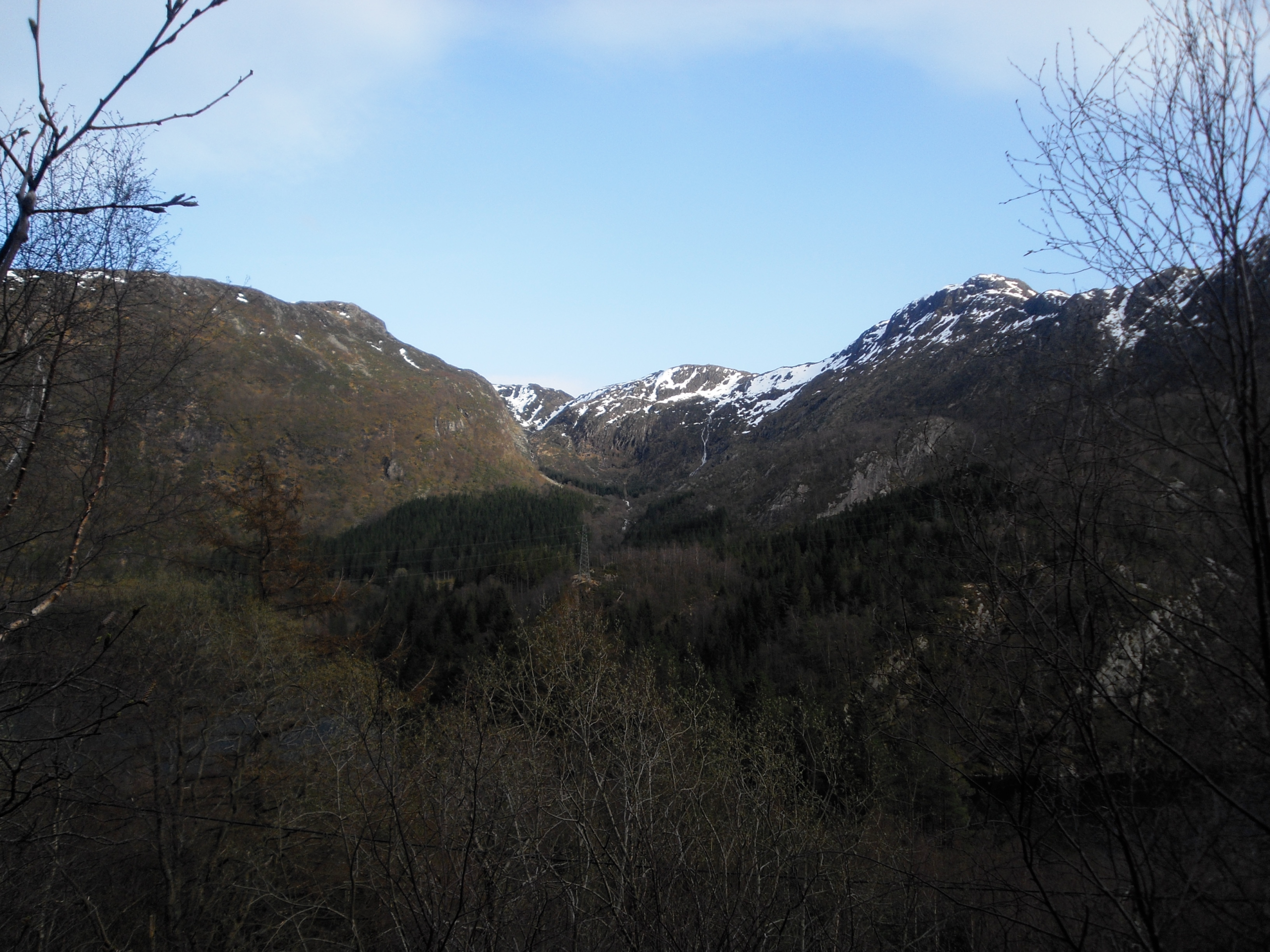
A man and his two daughters were walking through Isdalen outside Bergen when they made a discovery that would remain unexplained for more than half a century.
On a rocky slope lay the body of a woman.
She had been severely burned.
There was no identification giving investigators a name.
Near her were several personal objects, including bottles, an umbrella and rubber boots.
But one detail immediately made identification more difficult.
Labels and other identifying marks had been removed from clothing and belongings.
Someone appeared to have taken considerable care to remove clues that could reveal where the items had come from.
That did not prove who had removed them.
It did not explain why.
But it gave police their first indication that identifying this woman would not be simple.
Police had a body, clothing and personal belongings. What they did not have was a name.
The autopsy provided more questions.
Soot was found in her airways and carbon monoxide in her blood, evidence that she had been breathing while the fire burned.
Barbiturates were also detected.
Police ultimately regarded suicide as the principal explanation.
But the evidence never established every step of what happened in the valley.
Chapter Two
Then Police Found 2 Suitcases
The most important breakthrough came away from the valley.
Two suitcases at Bergen Railway Station were connected to the unidentified woman through fingerprint evidence.
Suddenly investigators possessed much more than the objects found beside her body.
The luggage contained clothes.
Wigs.
Spectacles.
Foreign currency.
Maps and travel information.
And a notebook covered with combinations of letters and numbers.

Once again, identifying marks had been removed from many of the belongings.
Whoever the woman was, her possessions contained remarkably little that could easily lead police to a family, employer or permanent home.
The notebook initially looked mysterious.
But this is where one common retelling of the Isdal Woman mystery becomes misleading.
The entries were not an unsolved secret cipher.
Investigators were able to interpret the letters and numbers as dates and destinations.
It was effectively a travel log.
And the journeys recorded there helped police uncover something even stranger.
The Numbers
2 suitcases. At least 8 recorded aliases. One woman whose real name remained unknown.
Chapter Three
A Woman With at Least 8 Names
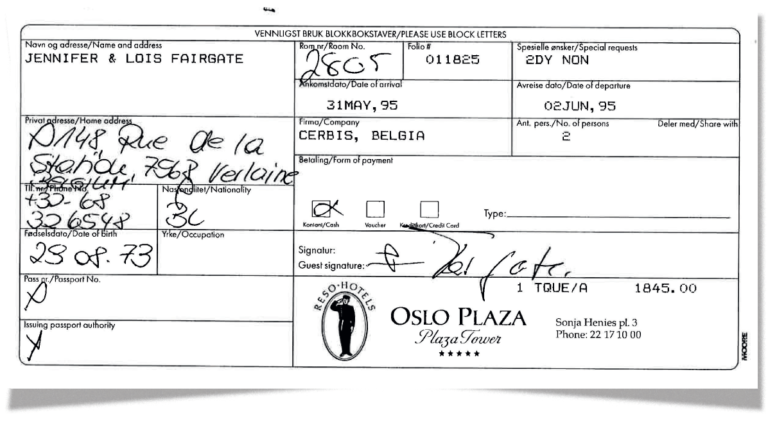
Police began comparing the woman’s movements with hotel registration records.
One name became another.
Then another.
Genevieve Lancier.
Claudia Tielt.
Vera Schlosseneck.
Claudia Nielsen.
Alexia Zarna Merchez.
Vera Jarle.
Finella Lorck.
Elisabeth Leenhouwfr.
Spellings vary slightly between later records and transcriptions.
But the central fact does not.
None of the identities could be established as her real one.
Dates of birth changed.
Addresses changed.
Occupations changed.
She often presented herself as Belgian and completed forms in French or German.
The aliases were detailed enough to get her through hotel reception desks.
But none led investigators to the life behind them.
Investigators could reconstruct where the woman travelled. They still could not answer the simplest question: who was she?
Another popular version of the story says she carried several false passports.
That claim should be treated carefully.
The documented aliases came from hotel registrations and travel records.
The two station suitcases did not contain eight physical passports.
Chapter Four
Her Last Confirmed Hotel Stay
The final confirmed hotel identity was Elisabeth Leenhouwfr.
Under that name, the woman stayed at Hotel Hordaheimen in Bergen.
On November 23, she paid her bill in cash.
She checked out of room 407.
She asked for a taxi.
That is considered her last confirmed sighting.
Six days later, she was found in Isdalen.
What happened between those two moments has never been reconstructed with certainty.
Where did she go after leaving the hotel?
Did she travel alone?
Why did she enter the valley?
And why had she spent months moving through Europe under names that apparently belonged to nobody?
Chapter Five
Was She a Spy?
It is easy to understand why the Isdal Woman mystery attracted espionage theories.
Europe was deep in the Cold War.
The woman travelled frequently.
She used false identities.
She possessed wigs.
Labels had been removed.
She kept her travel information in abbreviated form.
All of that sounds like the beginning of an intelligence story.
But suspicion is not proof.
No decisive evidence has established that the woman was an intelligence agent.
Nor has decisive evidence established that another person killed her.
Researchers at the University of Bergen have specifically warned against treating attractive theories as established facts when the evidence does not support them.
Police regarded suicide as the most likely explanation.
Yet that conclusion did not solve her identity.
Nor did it explain every strange detail surrounding her movements and possessions.
What We Can Say
Her identity was deliberately concealed. The evidence does not tell us with certainty why.
Chapter Six
Her Teeth Revealed Something Her Names Could Not
Decades after the original investigation, scientists returned to evidence that had survived.
Modern analysis of her teeth and biological material offered new information.
Isotope evidence pointed toward a childhood in south east Germany, with later residence farther west in Europe.
DNA analysis supported European ancestry.
These findings narrowed the geographical possibilities.
But geography is not identity.
A region cannot tell investigators who her parents were.
It cannot provide a childhood photograph.
It cannot explain why she travelled the way she did.
And so the Isdal Woman mystery gained new information without gaining the one thing it had lacked from the beginning.
A name.
Final Chapter
More Than 55 Years Without an Identity
The unknown woman was buried at Møllendal cemetery in Bergen on February 5, 1971.

Her grave did not receive the real name investigators had searched for.
More than five decades later, that remains unchanged.
Investigators know where she travelled.
They know some of the hotels where she stayed.
They know the false names she wrote down.
They know what was inside her suitcases.
Modern science has even provided clues about where she may have spent her childhood.
Yet no publicly confirmed identification has supplied the answer.
And that is what makes the Isdal Woman mystery so unusual.
It is not a case without clues.
It is a case overflowing with them.
Two suitcases.
At least eight names.
A record of journeys across Europe.
Removed labels.
Wigs.
Foreign money.
DNA.
Teeth that remembered where she grew up.
Everything except the one detail that mattered most.
She left behind enough information to trace a journey across Europe, but not enough to tell the world who had made it.
Another Mystery Is Waiting
Follow The Second Envelope
Unsolved disappearances, strange documents, forgotten clues and true mysteries where one detail changes everything.
Follow The Second Envelope on FacebookMore Unsolved Mysteries
Two handwritten notes remained unreadable even to professional code breakers. Read the Ricky McCormick cipher mystery .
A young woman disappeared from a cruise ship before sunrise. Read the Amy Bradley disappearance .
Historiske Mysterier: The Isdal Woman Case File
Bergens Tidende: Archive Review of the Case
University of Bergen: Review of Evidence and Competing Theories
BBC World Service: Death in Ice Valley
Wikimedia Commons: Isdalen Location Photograph