The Footprints

Afew days before six people were found dead on an isolated Bavarian farm, Andreas Gruber noticed something in the snow.
Footprints.
They appeared to come from the nearby forest.
They led toward the farm.
But according to what Andreas later told people around him, he could not find tracks leading away again.
Then came other strange details.
A newspaper nobody in the household had bought.
A missing house key.
A damaged lock.
Footsteps heard above the living rooms.
Andreas searched the attic.
He found no one.
Days later, he was dead.
So was his wife.
His daughter.
Two grandchildren.
And a new maid who had arrived only hours before the killings.
Did someone enter Hinterkaifeck before the murders and remain hidden on the property?
• • •
The Hinterkaifeck Murders Began With Strange Warnings
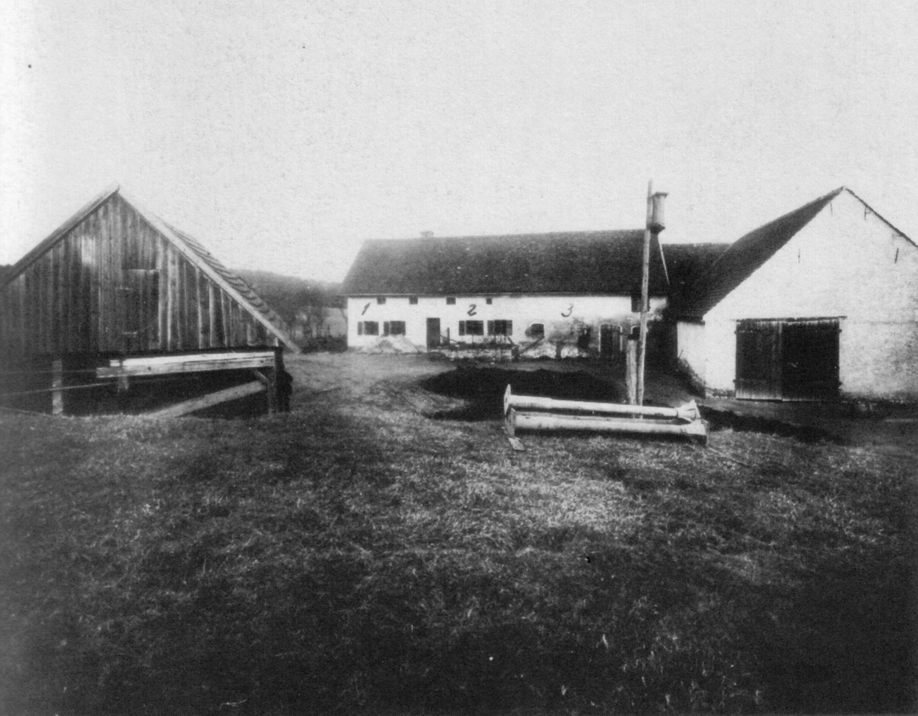
Hinterkaifeck was a remote farmstead near Gröbern in Bavaria, roughly seventy kilometres north of Munich.
The people living there were Andreas Gruber, 63, and his wife Cäzilia, 72.
Their widowed daughter, Viktoria Gabriel, also lived there.
She had two children.
Seven-year-old Cäzilia.
And two-year-old Josef.
The farm also employed domestic help.
Months before the murders, a previous maid had left.
Later accounts said she had been disturbed by noises around the property and believed the farm might be haunted.
By March 1922, the family needed a replacement.
But before the new maid arrived, Andreas began telling neighbours about things he could not explain.
One was a Munich newspaper found near the farm.
No one in the household claimed it.
And no one nearby was known to subscribe to that particular paper.
Then a house key went missing.
A lock near the machine room appeared to have been damaged.
And then there were the footprints.
Fresh snow had fallen.
Andreas said he found tracks leading from the forest toward the farm.
He reportedly saw no corresponding trail leading away.
The observation appears in contemporary newspaper reporting from April 1922, although police never had the chance to examine those original tracks before the murders. :contentReference[oaicite:0]{index=0}
• • •
There Were Footsteps Above the Rooms
The tracks were not the only warning.
The family also heard movement in the attic.
Andreas searched above the living quarters.
He found no stranger.
After the murders, investigators examined the attic themselves.
They found flattened areas in stored hay that looked as if people might have lain there.
They also observed disturbed roof tiles that could have provided views over parts of the property.
Those details have encouraged one of the case’s most famous theories: that someone had been secretly living above the family before the attack.
But that remains a theory.
No unknown intruder was ever physically identified in the attic.
No preserved evidence conclusively proves someone had been living there.
The attic evidence is real, but the idea that the killer lived secretly above the family before the murders has never been conclusively proven.

Historical case image. Confirm reuse rights before rehosting.
• • •
The New Maid Arrived on March 31
On March 31, 1922, Maria Baumgartner arrived at Hinterkaifeck to begin work as the new maid.
Her sister accompanied her to the farm.
She stayed for about an hour.
Then she left.
Maria had barely begun her first day.
By that night, all six people on the property would be dead.
Investigators later reconstructed the likely sequence.
Four members of the family appear to have been attacked in the barn area.
Those victims were Andreas, Cäzilia, Viktoria and young Cäzilia.
Maria Baumgartner was killed inside her room.
Two-year-old Josef was killed inside the living quarters.
The weapon was a heavy farm tool, commonly described as a mattock or Reuthaue.
It belonged to the farm.
The tool itself was not found immediately.
It was later discovered during demolition work at the property in 1923.
• • •
Four Bodies Were Found in the Barn
The murders were not discovered immediately.
On April 1, young Cäzilia failed to appear at school.
The family also missed church.
Visitors arrived at the farm and received no answer.
On April 4, concern finally became impossible to ignore.
A mechanic named Albert Hofner came to repair farm machinery.
He worked for hours without seeing anyone from the household.
Later that day, neighbour Lorenz Schlittenbauer went to Hinterkaifeck with Michael Pöll and Jakob Sigl.
Inside the barn, they discovered four bodies clustered beneath straw and other material.
They then entered the living quarters.
There they found Maria Baumgartner.
And Josef.
No one at Hinterkaifeck was alive.

Real historical crime-scene image. Original photographs are held by the Munich State Archive; republication permission should be confirmed.
• • •
The Crime Scene Had Already Been Disturbed
The investigation faced problems almost immediately.
Before police secured the farm, people had already entered the property.
At least two bodies in the barn had been moved by one of the men who discovered them.
The scene was later reconstructed for police photography.
That means some of the surviving photographs do not necessarily show the precise positions in which the victims were originally found.
Only five official crime-scene photographs are known from the investigation.
They were taken on April 5, 1922, by Andreas Biegleder of the Munich police photographic service.
The originals are preserved in the Munich State Archive. :contentReference[oaicite:1]{index=1}
For a case that would become one of Germany’s most famous unsolved murders, the surviving visual record was remarkably limited.
• • •
The Bedroom Added Another Piece
The police also photographed the bedroom used by Viktoria and her children.
Josef’s cradle was still there.
The room became one of the five documented crime-scene locations photographed the morning after investigators arrived.
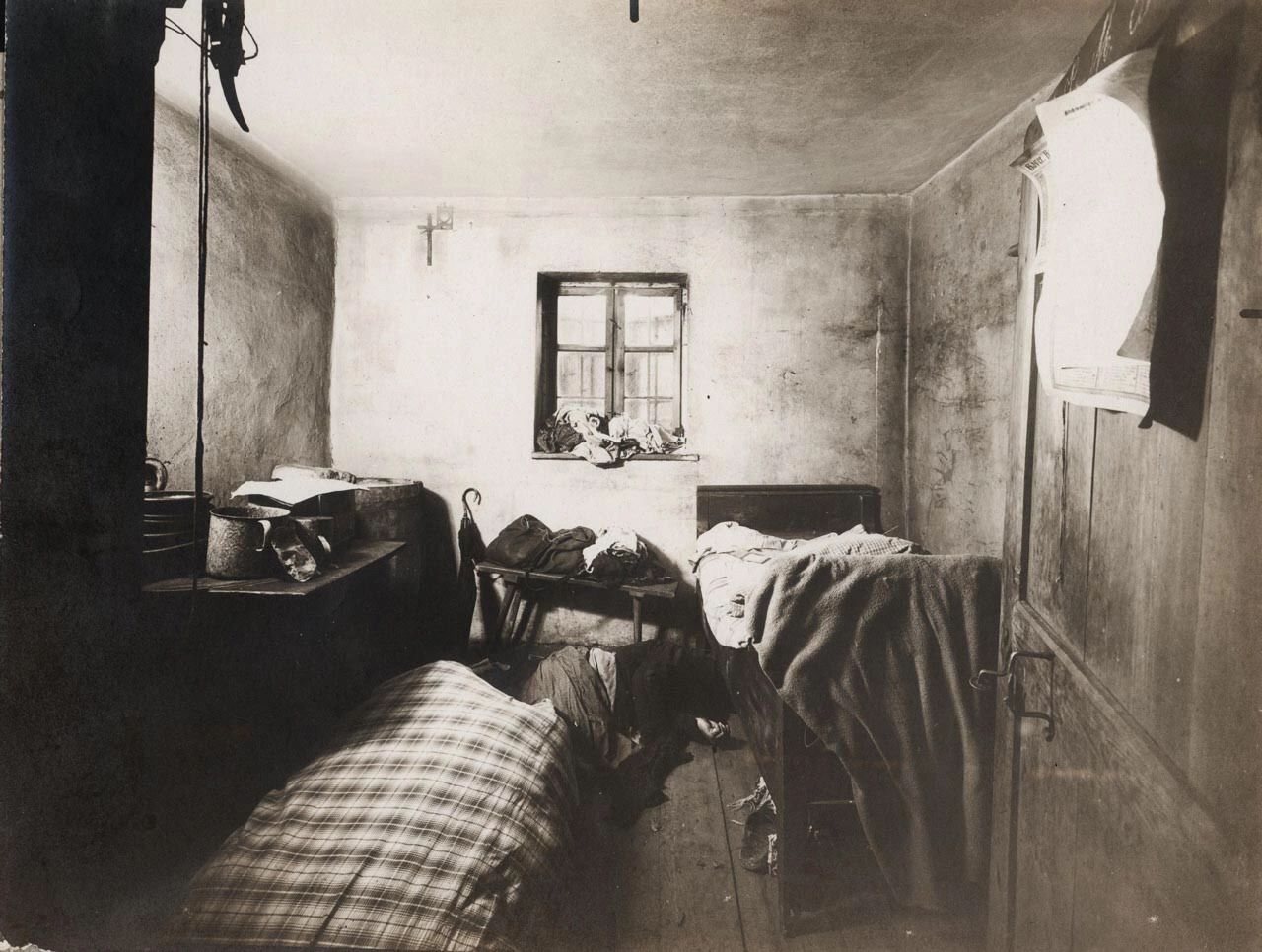
Real historical case image. Confirm archive/republication rights before permanent rehosting.
The violence inside the living quarters also complicated ideas about motive.
If robbery was the objective, why kill the newly arrived maid?
Why kill a two-year-old child?
Why remain at the property afterward?
Those questions pushed investigators toward people who might have had a personal connection to the household.
• • •
Someone May Have Remained at the Farm
This is one of the most unsettling parts of the Hinterkaifeck case.
The murders are believed to have occurred on March 31.
The bodies were not discovered until April 4.
During that interval, there were signs of activity around the property.
A passer-by later reported seeing a fire burning in the farm’s oven on the night after the murders.
The animals were found alive.
Food had apparently been used.
There were indications that someone may have continued moving through the property.
However, some popular versions overstate the certainty of details such as exactly how often the cattle were fed or milked.
The historical chronology itself notes that the extent to which the animals were tended between the murders and discovery is uncertain. :contentReference[oaicite:2]{index=2}
What can be said safely is more disturbing than embellishment.
The farm was not simply abandoned and silent after the killings.
There were signs of activity.
And nobody has ever conclusively established who was responsible for it.
• • •
The Attic Was Examined After the Murders
When investigators searched the upper areas of Hinterkaifeck, they found more details that would fuel speculation for decades.
There were impressions in hay stored upstairs.
A piece of smoked meat had been freshly cut.
Some roof tiles had been displaced in ways that could have allowed someone to look down over the courtyard.
Hay had reportedly been spread along part of the attic route near the chimney.
Investigators wondered whether it might have reduced the sound of footsteps.
But again, interpretation matters.
These observations do not prove the killer had secretly occupied the attic before the murders.
They show only that the attic contained unusual physical details investigators considered important.

Historical image associated with the case. Confirm original attribution and reuse rights before rehosting.
• • •
Investigators Had Suspects but No Killer
The murder investigation continued for decades.
Police considered people who knew the family.
They examined neighbours.
Former workers.
Travelers.
People with financial motives.
People connected to Viktoria.
And people whose behaviour after the murders attracted suspicion.
Lorenz Schlittenbauer became one of the most frequently discussed names.
He had been involved with Viktoria and had argued with the family over the paternity of Josef.
His behaviour at the crime scene later attracted considerable suspicion.
But suspicion is not proof.
He was never convicted of the murders.
Other suspects came and went.
No prosecution resolved the case.
Decades passed.
The farm itself did not.
Hinterkaifeck was demolished in 1923.
The murder weapon was discovered during that demolition.
But even finding the tool used in the killings did not identify the person who wielded it.
• • •
The Footprints: Reality Check
Verified: Six people were killed at Hinterkaifeck on or around March 31, 1922.
Verified: The victims were Andreas and Cäzilia Gruber, Viktoria Gabriel, Cäzilia Gabriel, Josef and Maria Baumgartner.
Verified: Maria Baumgartner arrived to begin work at the farm on the day of the murders.
Documented report: Andreas Gruber told others shortly before his death that he had seen footprints leading toward the farm in fresh snow.
Documented report: The household had experienced unexplained noises around the attic.
Verified: Investigators found unusual impressions and other details in the attic after the murders.
Verified: Five official crime-scene photographs were taken on April 5, 1922.
Verified: Four bodies were discovered in the barn area and two inside the living quarters.
Verified: The murder weapon was a farm tool later recovered during demolition of the property.
Not established: That the murderer lived secretly in the attic before the killings.
Not established: That any single named suspect committed the murders.
Still unresolved: Who killed the six people at Hinterkaifeck and why.
The Tracks Led In
The Hinterkaifeck murders contain many details that became larger with every retelling.
The isolated farm.
The attic noises.
The missing key.
The unknown newspaper.
The signs of activity after the killings.
But one image remains more powerful than almost all the theories.
Footprints in fresh snow.
Leading from the forest.
Toward a farm where six people would soon be dead.
And according to the man who noticed them, no clear tracks leading back out.
Andreas Gruber had seen the warning.
He told people about it.
But whatever made those tracks was never identified.
More than a century later, the question remains.
Who came to Hinterkaifeck?
• • •
Which Detail Would You Investigate First?
The footprints. The missing key. The attic. The unknown newspaper. Or the activity after the murders.
Which clue do you think matters most?
More Mysteries From The Second Envelope
Follow The Second Envelope
Real cases. Real evidence. Questions that still have no answer.
Sources and Image Credits
Hinterkaifeck.net — original crime-scene photographs and Munich State Archive information
Hinterkaifeck.net — case chronology
Hinterkaifeck.net — crime-scene and attic documentation
Hinterkaifeck Wiki — documentation of the five 1922 police photographs