She Checked Into an Oslo Hotel Under a False Name. Then Police Found the Labels Cut From Her Clothes

The Jennifer Fairgate mystery began with a young woman who entered one of Oslo’s best-known hotels using an identity that investigators would later discover was false.
It was May 1995.
She called herself Jennifer Fergate.
The hotel also recorded the surname as Fairgate, which is why both spellings became attached to the case.
She claimed to live in Belgium.
But the address she wrote down did not exist.
The postal code was wrong.
The telephone information did not match.
She also listed a second guest.
That person could not be identified either.
Then, on June 3, hotel security entered Room 2805.
The woman was dead on the bed.
A 9 mm Browning pistol was with her.
Police searched for something that would reveal who she was.
No passport.
No wallet.
No credit card.
No keys.
And when investigators examined her clothing, they discovered something even stranger.
Almost every identifying label had been deliberately removed.
Why would a woman enter a luxury hotel under a false identity and remove so many ordinary clues that could reveal who she really was?
• • •
The Jennifer Fairgate Mystery Started With a False Hotel Form
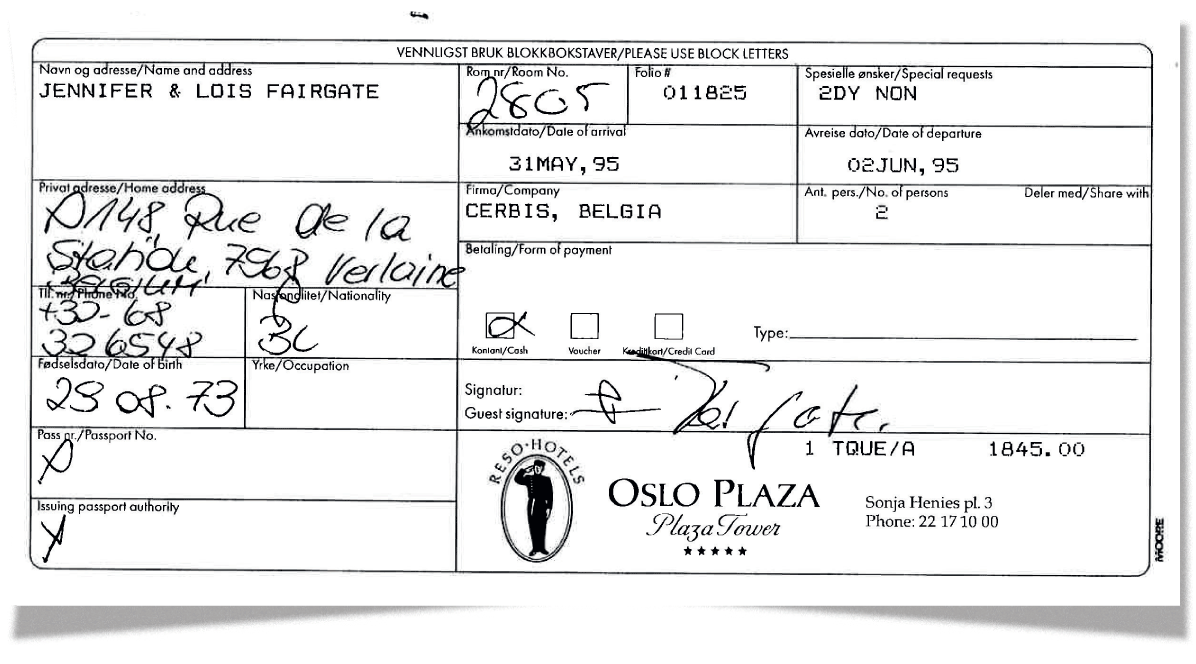
The woman checked into Oslo Plaza on May 31, 1995.
On the registration form, she wrote the names Jennifer and Lois Fergate.
She gave an address in Verlaine, Belgium.
Investigators quickly found problems.
The postal code she supplied did not exist.
The street was not in Verlaine.
The telephone area code was wrong for the town.
And Belgian police reported that neither Jennifer nor Lois Fergate could be identified from the information provided.

This was not simply a traveler who had lost her identification.
The information she had voluntarily supplied appeared designed to lead investigators nowhere.
Even the company she claimed to work for could not be confirmed as written.
The case had begun with a name.
Almost immediately, that name became another mystery.
• • •
She Disappeared From Room 2805 for Nearly a Day
The hotel’s electronic key-card records provided investigators with a partial timeline.
Jennifer first entered Room 2805 at 10:44 p.m. on May 31.
The card was used again shortly after midnight.
It appeared again at 8:34 the following morning.
Then something unusual happened.
There was no recorded entry into the room again until 8:50 the next morning.
Witness evidence showed the room had been empty during part of that period.
VG’s reconstruction concluded that she was away for at least 20 hours and possibly as long as 24 hours.
Where she went remains unknown.
When she returned, she extended her hotel stay.
Later that day she ordered food from room service.
A hotel employee remembered the room as unusually tidy.
There appeared to be very little luggage.
Then the hotel began trying to collect payment.
Messages were sent to the television screen in Room 2805.
They were acknowledged.
But Jennifer did not come to reception.
• • •
One Watch Became a Real Physical Clue
On the woman’s wrist was a distinctive diving watch.
It was eventually identified as a Citizen Aqualand.
Investigators learned that the watch had been produced in January 1992.
The batteries created another clue.
Three batteries inside the watch carried an inscription that investigators interpreted as possibly indicating they had been changed in March 1995.
If police could identify the watchmaker who changed them, perhaps that person might remember the woman.
But no breakthrough came.

The watch illustrates what makes the Jennifer Fairgate mystery so unusual.
Police had physical objects.
They had serial numbers.
They had fingerprints.
They had a face.
Yet none of those things produced a confirmed name.
• • •
Almost Every Clothing Label Had Been Removed
Clothing can tell investigators where someone shops, what country an item came from, or even where it was repaired.
But someone had systematically removed those clues from the woman’s wardrobe.
Logos and labels were missing from almost all of the clothing police examined.
Some had been carefully cut away.
Others appeared to have been removed stitch by stitch.
One important label survived.
It was inside a grey blazer made by German fashion company René Lezard.
Removing it would have required cutting into the jacket’s lining.

The removal of the labels did not appear accidental. Ordinary identifying information had been systematically stripped from much of her wardrobe.
Her shoes provided another strange detail.
The manufacturer’s name had been removed from the insoles.
Only “Made in Italy” remained.
Police also learned that some clothing appeared to have German connections.
That became more interesting years later when new forensic work also pointed investigators toward possible links with Germany.
Still, no name emerged.
• • •
The Pistol Had Been Stripped of Its Identity Too
The Browning pistol found in Room 2805 presented investigators with yet another deliberately damaged identifier.
Its serial number had been removed.
According to the forensic report described by VG, the removal had been done professionally.
Specialists managed to recover portions of the serial number.
But they could not reconstruct enough of it to identify the individual weapon.

The pistol was linked to Browning’s factory in Herstal, Belgium.
That was an intriguing coincidence.
The woman’s false identity also pointed toward Belgium.
But the weapon’s origin did not prove she was Belgian.
Nor did it explain why her false address pointed toward the same country.
The pistol also contained no usable fingerprints identifying another person.
That left investigators with another object that raised questions without answering the central one.
• • •
Then Police Opened the Attaché Case
A black attaché case was found among the belongings associated with the woman.
Inside were 25 live rounds for the pistol.
The case itself contained almost nothing else.
But it did have one identifiable feature.
A small metal buffalo emblem.
Years later, image analysis connected the emblem to Braun Büffel, a German luxury leather manufacturer.

The pattern was becoming impossible to ignore.
A false identity.
A false address.
No passport.
No wallet.
Labels removed from clothing.
A weapon with its serial number erased.
A German-made briefcase containing ammunition.
Every new object seemed capable of telling investigators something.
None told them her name.
• • •
Was Someone Else Supposed to Be in Room 2805?
The reservation had been made for two people.
The second name was Lois Fergate.
No confirmed Lois was ever identified.
There were also conflicting memories about whether the woman had been seen with a man.
One hotel employee recalled seeing a dark-haired man with her.
Nobody confirmed that a man actually stayed in Room 2805.
Yet another detail complicated the picture.
When the room was initially prepared, an extra duvet was added because two guests were expected.
After housekeeping found only one person using the room, the second duvet was put away.
But when the woman was later found dead, two duvets were again on the bed.
Who moved it?
The evidence does not establish that another person was present.
But it adds another unresolved detail to the timeline.
• • •
Questions About the Death Scene Never Completely Disappeared
Police concluded that the woman had died by suicide.
Years later, forensic specialists examining the available material questioned some details of the scene.
One issue was the way the pistol was positioned in her hand.
VG reported that the woman’s grip was reversed from the way a handgun would normally be held.
The investigation also discussed the absence of expected gunshot residue or blood back spatter on her hands.
Those facts have led to continuing debate.
But they do not establish murder.
No alternative homicide scenario has been conclusively proven.
Questions about the forensic scene are not proof that another person killed her. The original police conclusion and later forensic doubts should be reported separately.
• • •
Her Fingerprints Didn’t Give Police a Name
Investigators recovered fingerprints from several objects in the room.
They were compared internationally.
They did not identify her.
The weapon itself reportedly carried no fingerprints that solved the case.
Her dental work was expensive and distinctive enough to attract attention.
But that failed to produce an identity too.
Even her age was uncertain.
She had claimed to be 21.
The original autopsy suggested she might be older.
Years later, improved dental analysis estimated that she was approximately 24 years old.
New testing also strengthened the possibility that she had spent part of her early life in Germany or nearby regions.
It was progress.
But not the answer investigators wanted.
• • •
Her Grave Was Opened More Than 20 Years Later
The unidentified woman was buried in Norway.
Her real name remained unknown.
More than two decades later, investigators and journalists returned to the case.
Her grave was opened.
Modern DNA, dental and isotope analysis offered new possibilities that had not existed in 1995.
Investigators gained more information about her likely age and geographical background.
Yet the central answer remained missing.
No confirmed real name.
No proven hometown.
No publicly identified family.
Decades later, the woman from Room 2805 was still known primarily by the false name she had written on a hotel form.
• • •
Jennifer Fairgate Mystery: Reality Check
Verified: An unidentified woman was found dead in Room 2805 of Oslo Plaza on June 3, 1995.
Verified: She signed the surname Fergate, while the hotel also recorded Fairgate.
Verified: The Belgian address, postcode and telephone information she supplied did not establish a genuine identity.
Verified: Police found no passport, wallet, credit card or keys that identified her.
Verified: Labels and identifying marks had been systematically removed from much of her clothing.
Verified: The serial number of the Browning pistol had been deliberately removed.
Verified: A black attaché case contained 25 live rounds.
Verified: She wore a Citizen Aqualand diving watch that investigators attempted to trace.
Verified: Fingerprint comparisons did not publicly reveal her identity.
Not established: That she was a spy, intelligence officer or assassin.
Not conclusively established: That another person killed her.
Still unresolved: Her confirmed real identity and the complete circumstances surrounding her death.
Every Object Told a Story Except Her Name
That is what makes the Jennifer Fairgate mystery different from a case with no evidence.
Investigators had evidence everywhere.
The registration form.
The clothes.
The watch.
The pistol.
The ammunition.
The attaché case.
The fingerprints.
The hotel key-card records.
And photographs of the woman herself.
Yet every trail seemed to stop before reaching her real identity.
Perhaps she deliberately intended to disappear behind an invented name.
Perhaps someone helped her conceal her past.
Perhaps the explanation is less dramatic than decades of speculation have suggested.
But more than 30 years after the door to Room 2805 was opened, the simplest question remains unanswered.
Who was she?
• • •
Which Clue Would You Investigate First?
Police had a false hotel registration, a distinctive watch, clothing with missing labels, an altered pistol, ammunition and fingerprints.
Which real piece of evidence do you think has the best chance of revealing her identity?
More Mysteries From The Second Envelope
Follow The Second Envelope
For documented mysteries, real evidence and original stories with unexpected turns, follow The Second Envelope on Facebook.
Sources and Image Credits
VG: Mystery at the Oslo Plaza — primary detailed investigation and real case imagery
VG: Mystery at the Oslo Plaza case summary