Jenny’s Ghost Knew What I Deleted
Jenny Vale has been dead for seven years when a voicemail leads a true-crime writer back to Room 214 and the evidence she helped erase.
Jenny’s Ghost Knew What I Deleted
Jenny Vale had been dead for seven years when she left me a voicemail.
That was not the strange part.
The strange part was the last six words.
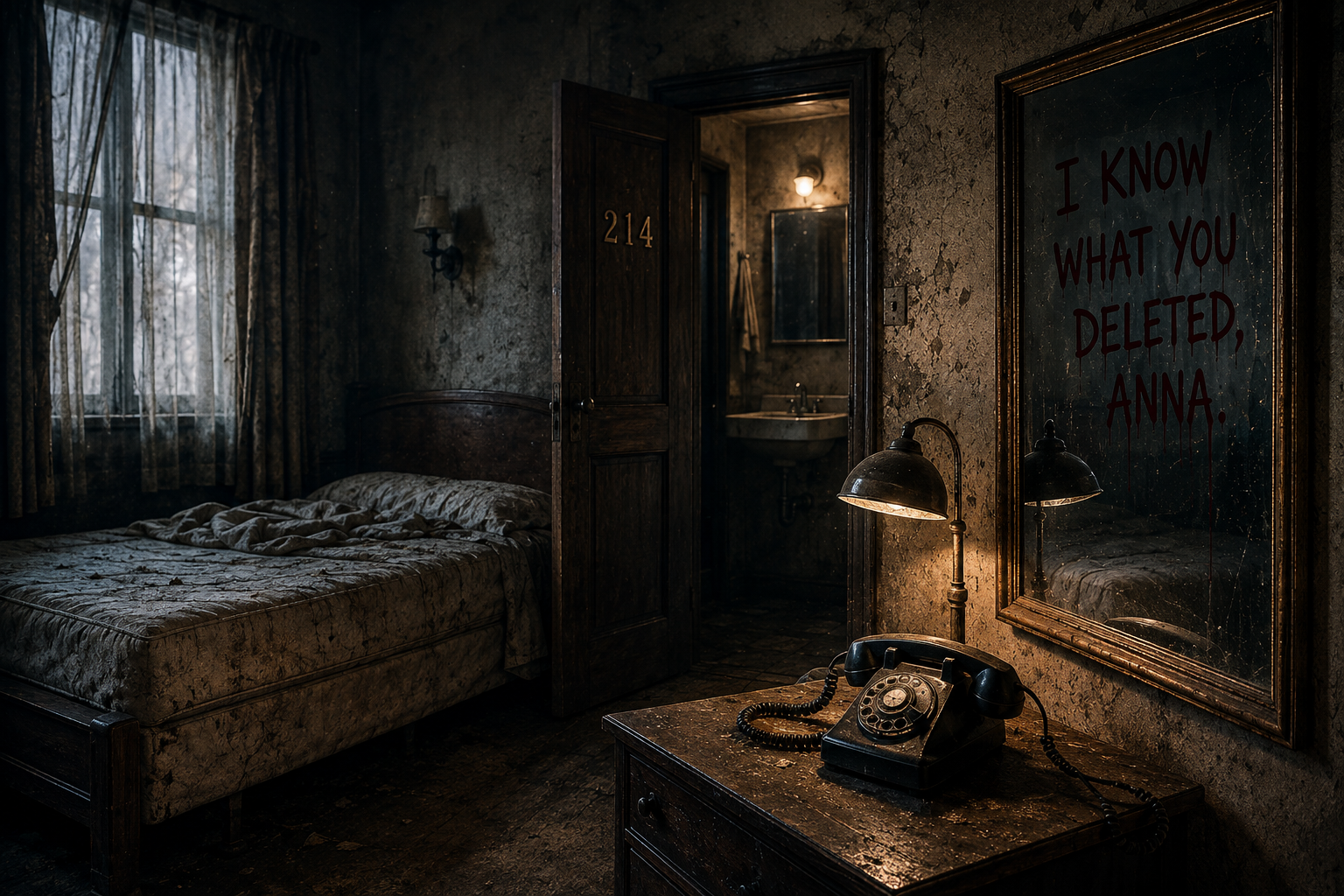
I know what you deleted, Anna.
I listened to the message three times before I turned on the lamp.
It was 3:17 in the morning.
Rain tapped against my bedroom window. My phone lay on the blanket, its screen showing an unknown number and a twelve-second recording.
The first six seconds contained only static.
Then came the soft chime of an elevator.
After that, Jenny spoke.
Her voice was older than I remembered. Tired. Almost tender.
I know what you deleted, Anna.
There was a pause.
Bring the red key to Room 214.
The message ended.
I had spent seven years writing about ghosts.
Not fictional ones.
Real-life hauntings. Voices recorded in empty houses. Dead children seen beside highways. Families who heard footsteps in rooms sealed for decades.
My articles had millions of views.
I did not believe most of them.
Fear could alter memory. Grief could turn a moving curtain into a dead husband. Old pipes could whisper. Bad wiring could make telephones ring.
Every phenomenon had a cause.
At the time, I believed every ghost mystery story eventually surrendered to a rational explanation.
That belief had made me famous.
Jenny Vale had made me famous first.
I was twenty-six when she disappeared from the Bellweather Hotel. I was a junior reporter desperate for a story that mattered.
Jenny was a schoolteacher with a red coat, a sharp laugh, and a habit of asking questions that made powerful men uncomfortable.
Three days after she vanished, police found a burned body beside the river.
My father, Detective Elias Cole, led the investigation.
Jenny’s boyfriend, Caleb Marsh, was arrested eleven days later.
The evidence looked perfect.
Threatening messages had been sent from Caleb’s phone. Jenny’s blood was found in his car. A hotel camera showed him entering the Bellweather shortly before she disappeared.
My article about the case was published nationally.
Caleb received a life sentence.
My career began.
I got out of bed and crossed the apartment to my office.
The red key was inside the bottom drawer of my desk.
It was heavy, old-fashioned, and stamped with the number 214.
Jenny had mailed it to me the day before she disappeared.
There had been no note.
I never told the police.
At the time, I convinced myself it meant nothing. Jenny had been sending me strange pieces of information for weeks—guest records, police reports, and photographs of unidentified women.
She believed something was happening at the Bellweather Hotel.
Women stayed there and lost hours of their lives.
Some woke in rooms they had never entered.
Others remembered a sweet chemical smell and the sound of a camera clicking.
My father said Jenny was obsessed.
He told me to stop answering her calls.
After she died, I placed the key in my drawer and tried to forget it.
Now it felt warm in my hand.
The Bellweather stood at the edge of town, six miles from the river.
It had closed four years earlier after guests began reporting what newspapers called the Bellweather Phenomenon.
To everyone outside Bellweather, it sounded like another ghost mystery story created to attract frightened tourists.
Telephones rang in empty rooms.
Elevators stopped at the second floor without being called.
Several visitors claimed they saw a woman in a red coat standing outside Room 214.
The stories brought ghost hunters for a while.
Then the building was condemned.
I reached the hotel shortly after five.
The rain had weakened to a gray mist. Boards covered most of the windows, but a pale light glowed behind the front doors.
I tried one.
It opened.
An elderly woman sat behind the reception desk.
She wore a gray coat buttoned to her throat. A white scar curved from her left ear to the corner of her mouth.
“You took your time,” she said.
I tightened my fingers around the key.
“Who are you?”
“The caretaker.”
“I thought the hotel was abandoned.”
“So does everyone else.”
Her gaze dropped to my hand.
“Second floor,” she said. “The elevator doesn’t work.”
“Did you call me?”
“No.”
“Do you know Jenny Vale?”
The woman looked toward the dark staircase.
“Everyone knows Jenny here.”
I wanted to question her, but somewhere above us, a telephone began ringing.
The sound echoed through the lobby.
One sharp metallic ring.
Then another.
The caretaker pointed toward the stairs.
“She doesn’t like to be ignored.”
Room 214 stood at the end of a narrow corridor.
The wallpaper had peeled away in long strips. Dark stains spread across the ceiling. Every door was covered in dust except one.
Room 214 looked as though someone had touched it recently.
The red key entered the lock without resistance.
Inside, the curtains were closed. A stripped mattress rested against one wall. Dust covered everything except the black telephone on the bedside table.
It rang as I approached.
I lifted the receiver.
“Jenny?”
Static crackled.
Then her voice answered.
Behind the mirror.
The line went dead.
The mirror above the sink had been fixed to the wall with four rusted screws.
I used the edge of the key to loosen them.
A memory card had been taped to the back.
Footsteps moved in the corridor.
I turned as a woman appeared in the doorway.
She was around forty, with rain-soaked hair and a pistol held close to her leg.
“Anna Cole?” she asked.
I raised my hands.
“Who are you?”
“Ruth Marsh.”
Caleb’s younger sister.
I had seen her outside the courthouse years ago. She had screamed at me as officers led Caleb away.
You helped them bury the truth.
“You sent the voicemail,” I said.
“I sent one of them.”
“One?”
Ruth closed the door behind her.
“Jenny recorded dozens of messages before she disappeared. Instructions. Names. Questions she wanted people to answer.”
“And you waited seven years?”
“I didn’t have the recordings. Your father did.”
She nodded toward the memory card.
“I found that last week in a box sold at an estate auction. It came from his house.”
My stomach tightened.
“My father’s belongings were never auctioned.”
“Not officially.”
The telephone rang again.
Neither of us moved.
Ruth stared at it.
“That isn’t me.”
The ringing stopped.
A heavy sound came from the floor below.
A door closing.
Ruth raised the pistol.
“We need to move.”
We carried the memory card into an old laundry room and inserted it into my laptop.
There were twelve video files.
The first showed Jenny sitting in Room 214.
A bruise darkened her cheek. Her red coat hung behind her.
“If you are watching this,” she said, “Detective Cole found me.”
My father’s name froze the air in my lungs.
Jenny explained the Bellweather Phenomenon.
There had never been anything supernatural about it.
The hotel manager drugged women through complimentary bottles of water. Hidden cameras recorded them while they were unconscious.
The recordings were used for blackmail.
When two women threatened to speak, they disappeared.
My father altered their reports.
In exchange, the hotel manager gave him money, information, and recordings he could use against judges, officers, business owners, and local politicians.
Jenny had discovered the arrangement.
So had Caleb.
That was why he was framed.
The second video showed documents. Payment records. Photographs. Copies of police evidence forms carrying my father’s signature.
In the final recording, Jenny looked directly at the camera.
“Anna, your father knows you’ve been receiving my files.”
I stopped the video.
Ruth looked at me.
“You sent them to him.”
“He was a detective. I thought he would investigate.”
“You told him where Jenny was.”
“I didn’t know what he was.”
My voice sounded small.
On the screen, Jenny continued.
“If he asks for the dashcam card, make a copy first.”
I closed my eyes.
The dashcam.
On the night Jenny vanished, I had driven past the Bellweather while following a police-radio call.
My camera captured eighteen seconds of activity beside the rear entrance.
My father took the card the following morning.
When he returned it, he told me the final section was corrupted.
He said damaged footage could compromise the investigation.
He instructed me to delete it before handing the card to the evidence clerk.
I obeyed.
“What was in those eighteen seconds?” Ruth asked.
“I don’t know.”
“You never watched it?”
I remembered my father standing behind me in the newsroom.
His hand rested on my shoulder.
The cold pressure of his fingers told me not to ask another question.
I had watched two seconds.
Long enough to see him beside a car.
Long enough to recognize Jenny’s red coat hanging from his arms.
“I knew enough,” I whispered.
A floorboard creaked outside.
Ruth shut the laptop.
The laundry-room door flew open.
A man rushed in.
He was older, broad-shouldered, with a silver hotel badge pinned to his coat.
Martin Voss.
The former Bellweather manager.
Ruth lifted the pistol, but Voss struck her wrist.
The weapon slid beneath a machine.
He grabbed the laptop.
I drove the red key into the back of his hand.
Voss screamed.
Ruth slammed a metal laundry cart into him, knocking him against the wall.
We ran.
The caretaker was waiting near the staircase.
“This way,” she said.
She led us through the kitchen to a red door beneath the stairs.
The key opened it.
Behind the door was a narrow storage room filled with police boxes.
My father’s boxes.
Inside them were pieces of evidence taken from women who had stayed at the hotel.
Jewelry.
Clothing.
Memory cards.
Signed statements that had never reached a prosecutor.
On the lowest shelf sat an old dashcam drive.
My name was written across it.
We heard Voss approaching.
Ruth pushed a cabinet in front of the door while I connected the drive to my laptop.
The deleted footage appeared immediately.
It had never been corrupted.
The video showed my father’s car beside the hotel.
He carried Jenny through the rear exit.
She was alive, but barely conscious.
Voss opened the trunk.
Then someone ran into view.
Caleb.
He struck Voss and pulled Jenny free.
My father fired his gun.
The bullet missed Caleb and shattered a light above the door.
Jenny and Caleb escaped in a second car.
My father stared after them.
Then he looked directly into my dashcam.
No ghost mystery story I had investigated had ever frightened me like that image.
The files that followed revealed the rest.
My father used the body of an unidentified hotel victim to fake Jenny’s death.
He altered dental records and planted Jenny’s belongings beside the river.
Caleb was arrested before he could prove Jenny had survived.
Jenny went into hiding.
She remained hidden because my father threatened to kill Caleb in prison if she returned.
Voss crashed through the storage-room door just as police sirens reached the hotel.
I had called them before entering the building.
It was a habit learned from years of interviewing people who lied.
Voss tried to run.
Ruth caught him in the kitchen with his own blood dripping from his hand.
By sunrise, the evidence was in police custody.
Caleb Marsh was released three weeks later.
The unidentified woman buried under Jenny’s name was eventually identified as a hotel employee who had disappeared eight years earlier.
Martin Voss was charged with murder, kidnapping, blackmail, and conspiracy.
My father’s medals were removed from the police station.
I published everything.
I included the deleted footage, Jenny’s recordings, and my own confession.
The article ended my career as a respectable crime writer.
It also became the most widely read story I had ever written.
Readers called it a ghost mystery story, a crime investigation, and a daughter’s confession.
But one question remained.
I called Ruth after Caleb’s release.
“Where is Jenny?”
Silence filled the line.
Then Ruth said, “She died six days before you received the voicemail.”
Jenny had spent her final years under another name, collecting evidence while cancer spread through her body.
Ruth had been with her when she died.
“What time?” I asked.
“You know what time.”
3:17.
I thought of the woman at the reception desk.
The gray coat.
The scar curving from her ear to her mouth.
Ruth sent me the final photograph ever taken of Jenny.
She was sitting in a hospice bed, older and painfully thin.
A white scar ran across her left cheek.
A gray coat hung beside her.
I called the Bellweather city office.
They told me the hotel had no caretaker.
It had been empty for four years.
That night, I played Jenny’s voicemail again.
At the end of the recording, after her final words, I heard something I had missed.
My own voice.
Faint and distant.
Not answering from my bedroom.
Whispering from somewhere beside her.
Room 214.
Then the voice began to cry.
The newspapers later called it a ghost mystery story, but that description never felt complete.
The ghost had not frightened me nearly as much as the living people who had buried her truth.
I had gone to the Bellweather to prove the ghost was fake.
By sunrise, I had proved everything except the woman who opened the door.
More Mystery and Suspense Stories
Read more related stories: Mara Was Told to Sign Away the Bakery Until the Receipt Tin Opened, A Hidden Record Proved Who Cared Before the Inheritance, and Grace Kept the Receipts No One Respected.
Explore Classic Ghost Mystery Stories
Readers who enjoy a ghost mystery story can also explore free classic ghost stories from Project Gutenberg.
This ghost mystery story is a work of fiction. Its characters, locations, crimes, and supernatural events were created for entertainment.