In 1872, a Ship Was Found Sailing Without Its 10 People. The Lifeboat Was Missing

The ship was still moving through the Atlantic.
But nobody appeared on deck.
No captain.
No crew.
No passengers.
When sailors approached the Mary Celeste in December 1872, they expected someone to answer.
Nobody did.
Men boarded the drifting merchant ship and discovered a scene that would become one of the most famous mysteries in maritime history.
The vessel had not been destroyed.
Food and drinking water remained aboard.
Personal belongings were still in the crew’s quarters.
Most of a cargo of 1,701 barrels of industrial alcohol remained in the hold.
But every person who had sailed aboard was gone.
Ten people had disappeared.
And one important object was missing with them.
The ship’s lifeboat.
What could make an experienced captain take his wife, his 2-year-old daughter and seven crewmen off a ship that was still capable of sailing?
• • •
The Mary Celeste Mystery Began With an Ordinary Voyage
The voyage was supposed to be business as usual.
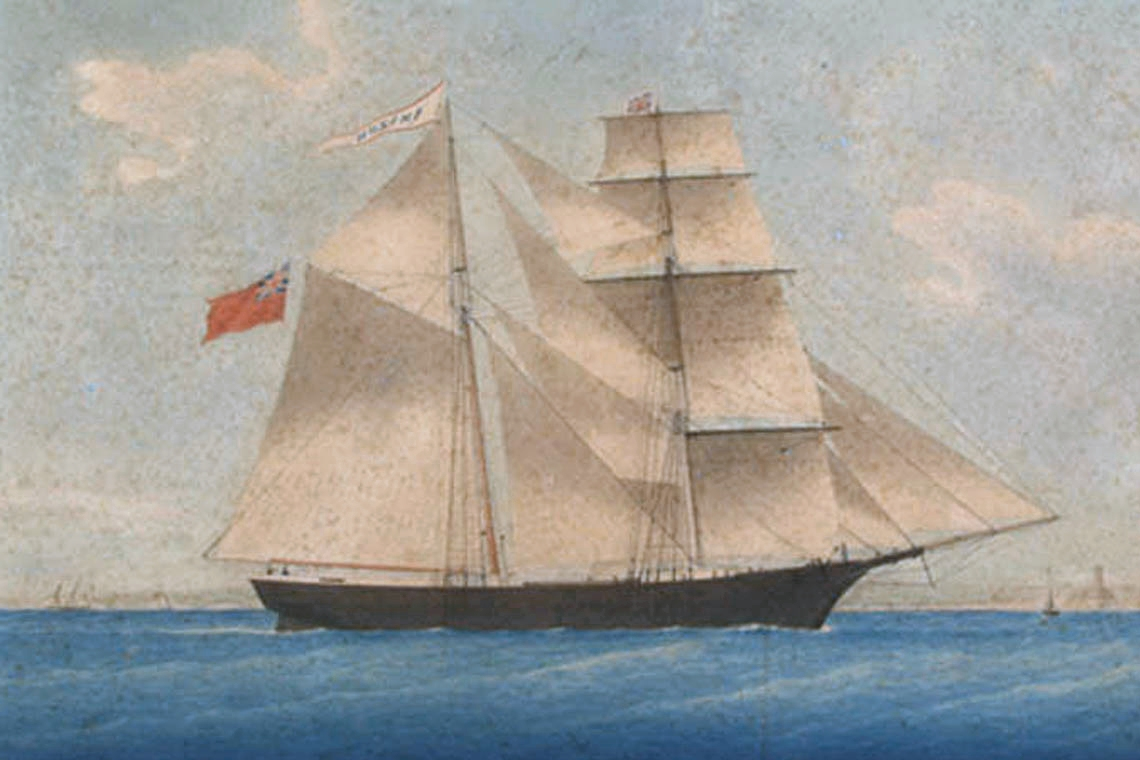
The Mary Celeste was a merchant brigantine bound from New York toward Genoa, Italy.
Its cargo consisted of 1,701 barrels of industrial alcohol.
Captain Benjamin Spooner Briggs commanded the vessel.
Briggs was an experienced seaman, and this voyage was more personal than most.
His wife, Sarah, was traveling with him.
So was their 2-year-old daughter, Sophia.
Seven crewmen completed the group.
There were 10 people aboard in total.

The vessel left the New York area in November 1872.
The Atlantic did not give them an easy crossing.
The ship encountered difficult weather during the voyage toward the Azores.
Still, nothing in the surviving record provides a simple explanation for what happened next.
The ship’s final surviving log entry was dated November 25, 1872.
After that, the voices of the people aboard disappear from the record.
• • •
A Wife and a 2-Year-Old Child Were Also Aboard
It is easy to think of the Mary Celeste as simply a story about a missing crew.
But that description hides one of the most haunting details.
Captain Briggs had brought his family with him.
His wife Sarah and their young daughter Sophia were passengers aboard the ship.

If Briggs ordered an evacuation, he was not making a decision that affected only professional sailors.
He would have been deciding whether putting his wife and small daughter into an open boat on the Atlantic was safer than allowing them to remain aboard the Mary Celeste.
That matters.
Whatever Briggs believed was happening must have seemed serious enough to justify an extraordinary risk.
Unless, of course, the evacuation was never intended to be permanent.
• • •
Another Ship Found the Mary Celeste
Early in December, sailors aboard another vessel, the Dei Gratia, noticed a ship behaving strangely in the Atlantic east of the Azores.
The vessel appeared to be drifting without proper control.
Captain David Morehouse brought the Dei Gratia closer.
The ship ahead of him was the Mary Celeste.
That was surprising.
The Mary Celeste had left New York before the Dei Gratia.
It should have been farther along its voyage.
A boarding party crossed to the vessel.
They found no one.
The ship remained. Its people did not.
The discovery was strange because the ship was damaged enough to raise questions, yet it was not a wreck.
There was water in the hold.
One of the pumps had been taken apart.
Charts had been disturbed.
But there was still a substantial supply of food and water.
Most of the cargo remained.
Personal belongings had been left behind.
And the ship was still capable of being sailed.
• • •
The Missing Lifeboat Changed Everything
One absence stood out.
The lifeboat was gone.
That clue makes the Mary Celeste mystery very different from a simple story of people suddenly disappearing from a deck.
The missing boat raises the possibility that the captain, his family and the crew deliberately left the ship.
The Mary Celeste’s lifeboat was missing when the ship was discovered. That strongly supports the possibility of an evacuation, although it does not tell us why the evacuation occurred.
And that creates an even harder question.
Why exchange a large sailing vessel for a small open boat in the Atlantic?
An experienced captain would know how dangerous that could be.
He would also know that leaving the ship could expose his wife and 2-year-old daughter to rough seas with very little protection.
Something may have convinced him that staying aboard was worse.

But what?
• • •
Was the Cargo the Problem?
The 1,701 barrels in the hold have long attracted attention.
They contained industrial alcohol.
Later theories proposed that leaking alcohol or dangerous vapor might have frightened the captain into believing an explosion was possible.
Nine barrels were later found empty.
But that does not prove that an explosion occurred or that alcohol fumes caused the evacuation.
In fact, the boarding party did not report the kind of obvious explosion damage that would neatly solve the case.
The theory remains attractive because it could explain a temporary evacuation.
Imagine Captain Briggs believing there was an immediate danger below deck.
His goal might not have been to abandon the Mary Celeste forever.
He might have intended to place everyone in the lifeboat only until the danger passed.
That possibility leads to one of the most tragic scenarios proposed for the mystery.
• • •
The Pump May Be Another Important Clue
When the boarding party entered the Mary Celeste, one of its pumps had been disassembled.
There was also water in the ship’s hold.
A modern investigation highlighted the possibility that problems with the pumps, combined with weather and uncertainty about how much water was entering the vessel, may have affected Briggs’s judgment.
If a captain cannot confidently measure the amount of water inside his ship, he faces a frightening problem.
The vessel does not have to be sinking.
He only has to believe it might be.
That distinction could explain why the Mary Celeste was later found seaworthy even if Briggs had genuinely believed his family and crew were in danger.
Briggs orders a temporary evacuation because he believes the ship may be unsafe. Everyone enters the lifeboat while remaining close to the Mary Celeste. If the small boat becomes separated from the larger vessel, the Mary Celeste could sail away while the 10 people are left exposed at sea.
It is plausible.
It is also still a theory.
No survivor returned to explain what actually happened.
• • •
Suspicion Quickly Turned Toward Foul Play
The empty ship eventually reached Gibraltar, where a salvage proceeding brought intense scrutiny to the discovery.
Officials considered whether something criminal had happened.
Had the crew mutinied?
Had pirates attacked?
Could the men from the Dei Gratia have known more than they admitted?
Newspapers also fed public suspicion.

The distinction between suspicion and evidence is important.
Investigators did not establish a proven case of piracy, murder or conspiracy that explains the disappearance.
There were no 10 bodies aboard the vessel.
There was no confirmed attacker.
There was no final confession.
The sensational possibilities survived because the actual answer did not.
• • •
Then Fiction Made the Mystery Even Stranger
The real Mary Celeste case was mysterious enough.
Later storytellers made it stranger.
In 1884, Arthur Conan Doyle published a fictional story inspired by the abandoned ship.
Other retellings followed.
Over time, dramatic details were repeated so often that some became confused with the historical record.
Stories of untouched meals, violent conspiracies, supernatural forces and impossible disappearances helped transform the vessel into a legendary “ghost ship.”
But the documented facts do not need decoration.
A real merchant ship left New York.
Ten real people sailed aboard.
The vessel was later found without them.
The lifeboat was gone.
The people never returned to explain why they left.
That is enough.
• • •
Reality Check: What Is Actually Known?
Verified: The Mary Celeste was discovered abandoned in the Atlantic in December 1872.
Verified: Captain Benjamin Briggs, his wife Sarah, their 2-year-old daughter Sophia and seven crewmen had sailed aboard.
Verified: That means 10 people were missing.
Verified: The vessel carried 1,701 barrels of industrial alcohol.
Verified: The lifeboat was missing when the ship was found.
Verified: One of the ship’s pumps had been disassembled.
Verified: Food, water, cargo and personal belongings remained aboard.
Verified: The missing people were never heard from again.
Not established: Murder, piracy, mutiny, supernatural activity or any other single dramatic explanation.
The unresolved question: Why did everyone leave the Mary Celeste, and what happened to them afterward?
Perhaps They Expected to Come Back
More than 150 years later, one possibility remains especially unsettling.
Maybe Captain Briggs never intended to abandon his ship.
Perhaps bad weather, water in the hold, uncertainty about the pumps or concern about the cargo convinced him to order everyone into the lifeboat temporarily.
Perhaps the small boat stayed connected to the Mary Celeste for a time.
Then something went wrong.
A line could have broken.
The weather could have changed.
The larger vessel could have moved beyond reach.
Ten people in a small boat would then have watched their best chance of survival sail away without them.
We do not know that this happened.
But it fits one of the strangest facts of the case.
The ship survived.
The people did not return.
And the one object that might have carried them away was missing.
The lifeboat.
• • •
What Do You Think?
If you had been Captain Briggs and believed something dangerous was happening aboard the ship, would you have stayed?
Or would you have put your family and crew into the lifeboat?
What do you think made all 10 people leave the Mary Celeste?
More Mysteries From The Second Envelope
Follow The Second Envelope
For real mysteries, unexplained clues and original stories with unexpected turns, follow The Second Envelope on Facebook.
Sources
Smithsonian Magazine: Abandoned Ship: The Mary Celeste
Smithsonian Magazine: An Abandoned Merchant Ship Was Discovered Floating in the Atlantic in 1872
Wikimedia Commons: Mary Celeste historical image collection